Peng Gao receives NIH New Innovator Award for research measuring chemical exposure in blood and tissues
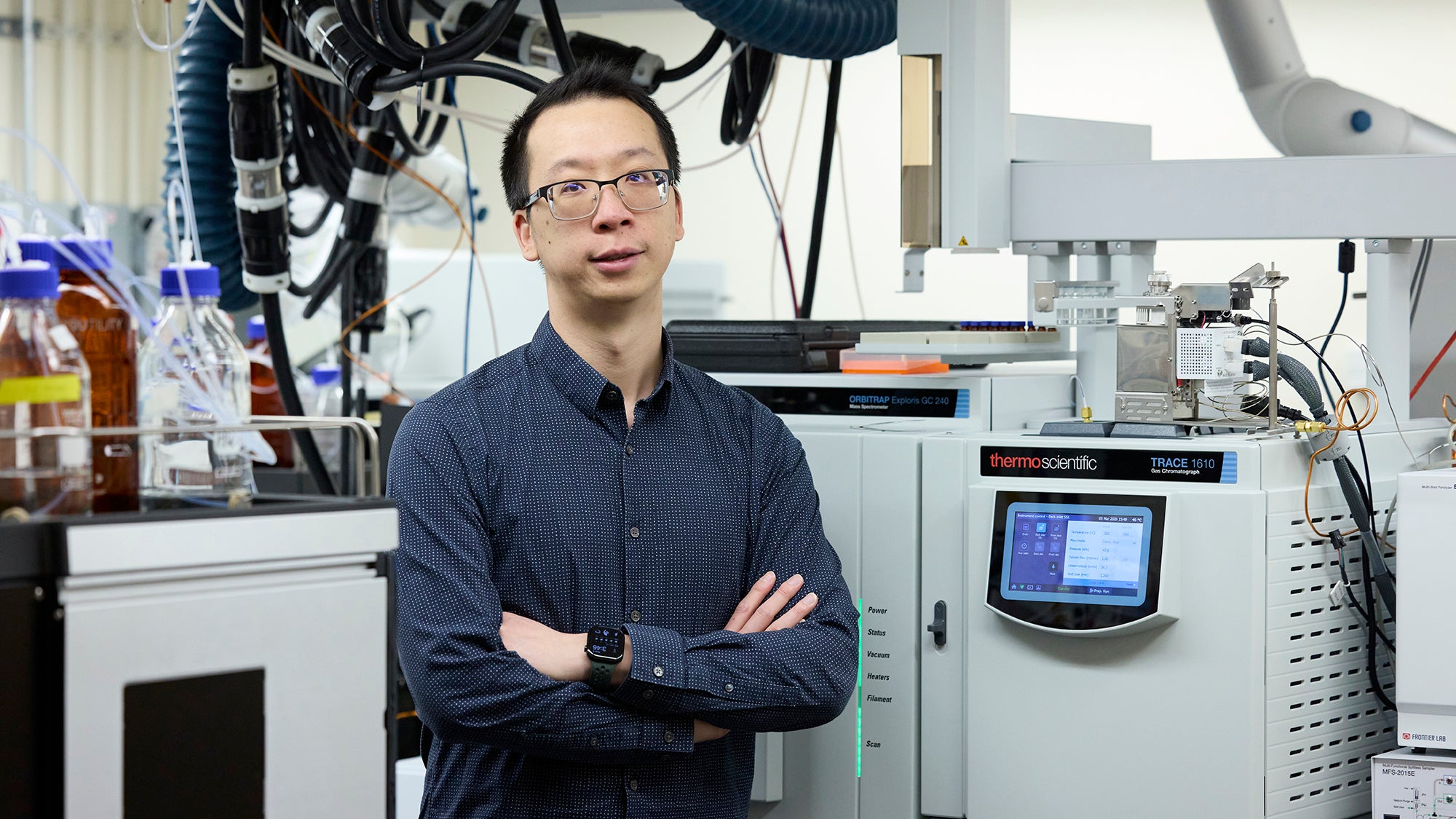
Peng Gao, assistant professor of environmental health and exposomics at Harvard T.H. Chan School of Public Health, was awarded an NIH Director’s New Innovator Award from the National Institutes of Health’s High-Risk, High-Reward Research program.
The award was one of 57 new research grants (including 42 New Innovator Awards) announced on Oct. 6 by the NIH to “support investigators pursuing bold ideas that challenge conventional approaches and could open new pathways to scientific discovery.”
Gao studies the “exposome”—the measure of an individual’s total environmental exposures over the course of their life and how those exposures impact biology and health. His new five-year, $3.61 million award, administered through the National Institute of Environmental Health Sciences (NIEHS), will support the project “Mapping Molecular Exposomics: From Blood Biomarkers to Tissue Architecture.”
Gao said that while environmental factors are thought to drive the majority of chronic disease risk, tools to measure exposures to chemicals such as flame retardants, pesticides, and air pollutants are surprisingly limited. “We’re exposed to thousands of chemicals every day, but we typically measure only a handful of them, and only in the external environment,” Gao said. His lab’s early work has found that some chemicals are persistent in blood, while others that barely show up in blood can build up to high levels in tissues, including in areas where tumors begin.
His new project will use high-resolution mass spectrometry to take a “chemical fingerprint” of a person’s blood, which will allow his team to detect more than 10,000 chemical features per sample. The researchers will then create maps showing exactly where environmental chemicals accumulate within human tissue. These efforts will help shed light on how chemicals travel from the bloodstream to specific locations in tissues, and which blood markers can identify hidden buildup in organs.
Gao and his colleagues will start with lung cancer as a proof of concept, using blood and tissue samples from established cohorts including the Boston Lung Cancer Study. However, the approach is designed to work in any tissue, from the brain in neurodegenerative disease to the liver in metabolic disorders, he said.
“If we can map how chemicals move from the bloodstream into tissues and where they concentrate, we can pinpoint the exposures that matter most for disease and act to reduce or prevent those exposures before people get sick. That’s the reward: shifting environmental health from reacting to disease to preventing it,” he said.
Gao is only the third researcher with a primary faculty affiliation at Harvard Chan School to receive a New Innovator Award since the program began in 2007.
His research is supported by the NIEHS and the Office of the Director of the National Institutes of Health under Award Number DP2ES039817.
Read NIH announcement:
NIH awards more than $237 million to advance bold biomedical and behavioral research
Learn more:
How pollutants interact inside the body to impact health (Q&A with Peng Gao, Harvard Chan School news)