Beyond Shelter conference highlights collaborative solutions to homelessness
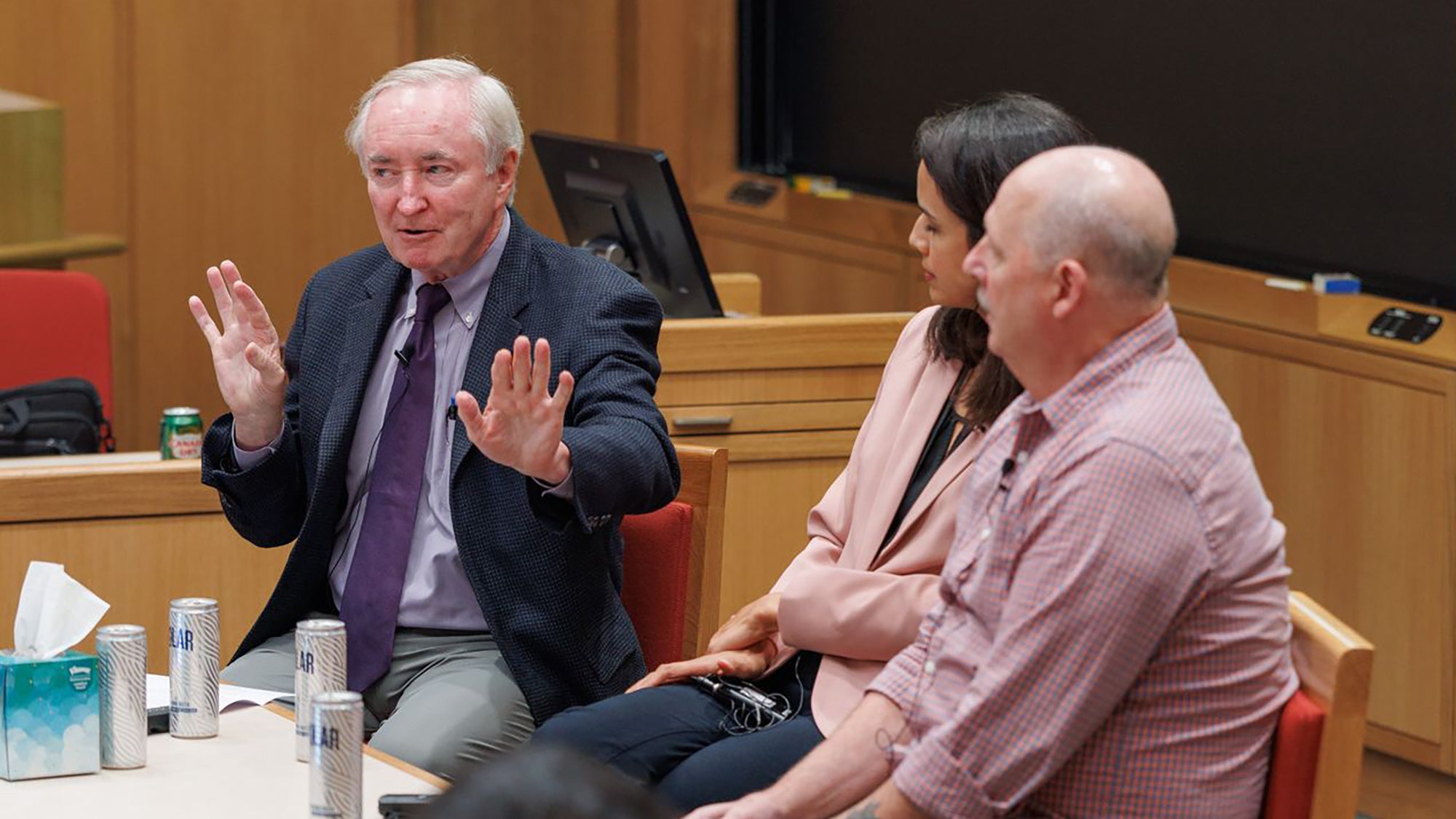
As the highly visible humanitarian crisis of homelessness reaches critical levels nationwide, the Initiative on Health and Homelessness (IHH) at Harvard T.H. Chan School of Public Health convened a host of organizations from across the University for a two-day deep dive focusing on practical solutions.
The Sept. 17-18 event explored homelessness from multiple perspectives, including urban, policy and systems change; housing policy; health, recovery, and outreach; lived experience; and storytelling to change how the public views and understands homelessness.
Co-chaired by Howard Koh, Harvey V. Fineberg Professor of Public Health Leadership at Harvard Chan School and faculty chair of IHH, and Peter Levesque, a fellow at the Harvard Advanced Leadership Initiative and Harvard Business School, the event featured national speakers including mayors and other government leaders, business leaders, researchers, practitioners and clinicians, social media influencers, and people with who have experienced homelessness.
Additional sponsoring organizations included Harvard Business School, Harvard Advanced Leadership Initiative, the Joint Center for Housing Studies at Harvard, the Bloomberg Center for Cities at Harvard, the Government Performance Lab at Harvard Kennedy School, the Harvard Urban Health Initiative, and the U.S. Chamber of Commerce Foundation.
Changing social norms

In opening the conference, Koh noted that the 50% reduction of veterans’ homelessness over the past decade represents a major sign of hope. He emphasized that building a true system for crisis response, permanent supportive housing, and prevention requires a commitment to investing in leadership and the workforce, fostering cross-sector collaboration, and humanizing the public narrative. Routinely walking by a vulnerable unhoused person on the street should never be regarded as the social norm, he said.
Jeff Olivet, IHH senior advisor, provided a brief history of homelessness in the U.S. noting that the 300,000-unit national surplus in affordable housing in 1971 has long since been erased such that today there is an estimated deficit of more than seven million units. “Homelessness is not accidental, it is not colorblind, and it is not inevitable,” he said.
Mayors Ras Baraka of Newark, New Jersey and Dean Trantalis of Fort Lauderdale, Florida, described their longtime commitments to ending the crisis through dedicated public-private collaborations, especially involving the business, public safety, and public health communities. Baraka said that his city’s efforts have led to declines in unsheltered homelessness and Trantalis described the inclusive and collaborative community-wide process that led to the clearance of a major homelessness downtown encampment in Fort Lauderdale.
Several panel discussions on housing policy solutions were moderated by Levesque who noted “the private sector is a powerful catalyst for systems change.” Bill Owens, chairman of the board of the National Association of Home Builders, discussed challenges in zoning, permitting, and building but also opportunities around innovations such as accessory dwelling units, 3D concrete printing, and modular housing.
Makinizi Hoover of the U.S. Chamber of Commerce noted that increasingly, workers cannot afford to live in communities where they work, thereby making it difficult for businesses to attract and retain talent. She argued that housing should be considered essential infrastructure especially since homelessness and affordable housing represent economic, as well as social, challenges.
Elevating lived experience
Chad Bojorquez, chief program officer of Destination: Home, a Silicon Valley-based non-profit dedicated to preventing and ending homelessness, discussed how his personal experience with homelessness fuels his work. One way the organization does so is by providing flexible cash transfers to help individuals and families on the verge of homelessness, a strategy, now being disseminated nationally, that was proven effective through a recent major study.
Another panel focused on how social media influencers can change public perceptions of homelessness, build community support for unhoused people, and create opportunities for change. Creator Roya Fox shared her social media posts about homelessness, highlighting the use of humor and emotional connection to deconstruct stigma and combat misinformation.
To end the conference, clinicians Katherine Koh, Mike Jellison, and Jim O’Connell, all with the Boston Health Care for the Homeless Program (BHCHP), shared lessons from delivering medical, mental health, and substance use disorder care to people experiencing homelessness on the street. Their approach starts with meeting people with compassion, flexibility, trust, and without assumptions about what someone needs.
“Meet them where they are. Don’t go in with an agenda. Don’t go in knowing what you think they need already,” said Jellison, a recovery coach who has experienced homelessness.
Elevating the voices of people with lived experience of homelessness was a major theme throughout the two days. Future IHH research will explore how they can effectively serve as future leaders in more equitable and humane decision-making about homelessness policies and programs, Koh said.
During the conference, Derek Winbush shared his story of surviving years on the street before finding a support system at BHCHP and currently serving as a leader on its board of directors. His advice to those who want to help homeless people: “Be kind.”