
A world without lead exposure: Pursuing the path forward with Mary Jean Brown, ScD
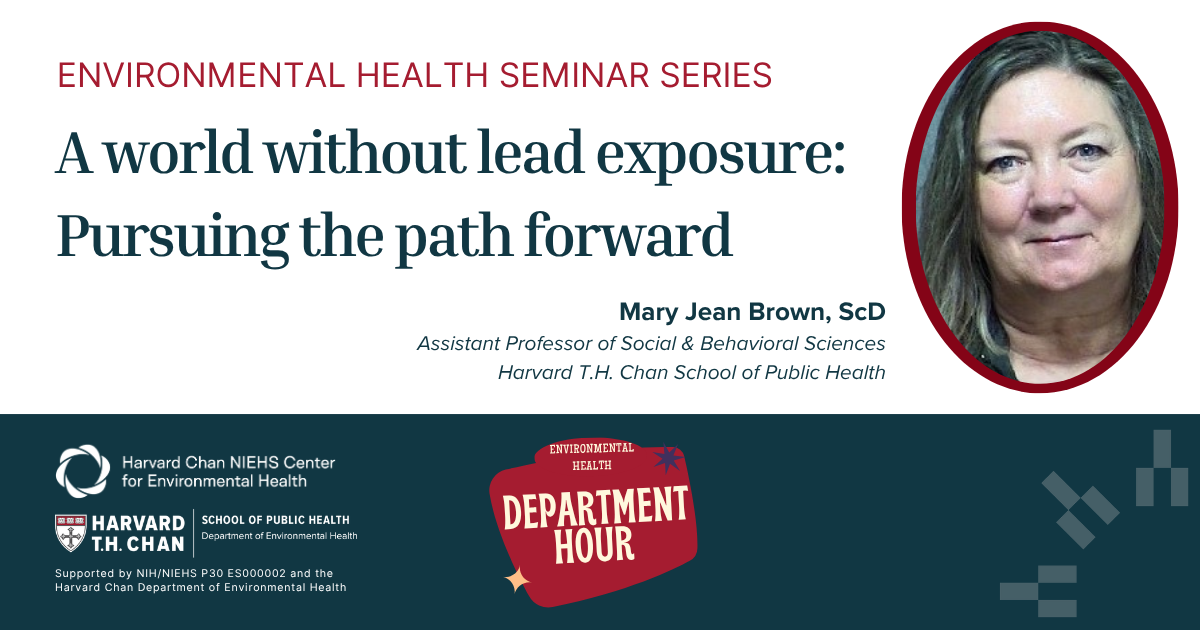
Please join the Harvard Chan NIEHS Center for Environmental Health and the Department of Environmental Health for a talk by Mary Jean Brown, ScD, Assistant Professor of Social and Behavioral Sciences at the Harvard T.H. Chan School of Public Health. Dr. Brown will discuss “A world without lead exposure: Pursuing the path forward.”
This event will be held in person (HSPH Bldg. 1, 1302) and via Zoom. Register here
Trainee meeting for students and postdocs immediately following the seminar, 2-2:30 pm, in 1306A! Come in-person to discuss research interests, career plans, and funding opportunities. RSVP here!
Abstract
A recent World Bank Report ‘A World Without Lead: Paving the Path to a Healthy Productive Future’ describes the global lead poisoning crisis, and its impacts on health, the environment, and human capital. The report offers a roadmap for eliminating exposure, comprising strategic investments, policy reforms and foundational public health practices like monitoring and surveillance that every country can use to address this crisis.
Removal of lead from gasoline reduced average blood lead levels globally but was not the only source of lead. Global lead consumption exceeded 12 million tons in 2022. Toxic emissions are routinely released from formal and informal lead mining, smelting and recycling and contaminate adjacent communities. Lead is found in a multitude of foodstuffs, remedies, low fire glazed pottery, jewelry, leaded residential paint and water pipes. One study estimated that 800 million children worldwide, most living in low-middle income countries, have blood lead levels known to affect learning, behavior and later adult health.
But good news: fugitive emissions from lead mining and smelting can be controlled, contaminated sites can be cleaned up, and old lead mines can be permanently closed. Lead contamination of foodstuffs and leaded paint have been successfully regulated. Population-level blood lead surveillance, together with studies of blood and environmental lead levels in areas with known lead contamination, help countries and communities identify risks and monitor progress to eliminate the danger. And, the costs of these interventions are far less than the costs of letting the exposure continue.
In this seminar, Dr. Brown will describe the current status of lead exposure with a focus on low and middle income countries, the expected costs/benefits of eliminating exposure globally, and the work that remains to be done.
About the speaker
Mary Jean Brown was on the faculty of the Harvard T.H. Chan School of Public Health from 2003-2026, where she taught courses in public health practice. She retired as Chief of the Lead Poisoning Prevention Branch at CDC in 2006. Dr. Brown co-authored A World Without Lead: Paving the Path to a Healthy, Productive Future and works regularly with domestic and international public health agencies and non-governmental organizations such as the World Health Organization UNICEF, and Human Rights Watch on issues related to health and housing, including developing policies to eliminate childhood lead poisoning. She has published more than 150 peer reviewed scientific articles, commentaries, and policy documents and conducted epidemiological studies of housing interventions for lead, asthma, and injuries in the United States and internationally.
Dr. Brown received a Doctor of Science degree from the Harvard School of Public Health in 2000. She received a Bachelor of Science in Nursing degree from Boston College in 1982.
Speaker Information

Organizers
ⓘ Harvard Chan School hosts a diverse array of speakers, invited to share both scholarly research and personal perspectives. They do not speak for the School, and hosting them does not imply endorsement of their views, organizations, or employers.