Apple Women’s Health Study
The Apple Women’s Health Study is the first long-term research study of this scale and scope that aims to advance the understanding of menstrual cycles and their relationship to various health conditions.
A Transition of Seasons: Sleep Patterns and Changes in Perimenopause
Researchers are studying sleep changes and patterns during perimenopause for participants in the Apple Women’s Health Study.
MAY 2026: Good quality sleep – and getting enough of it – is important for both your physical and mental health. Most adults need between 7 and 9 hours of sleep per night, but different seasons of life can make this amount harder to get. Sleep difficulties are about twice as common in women as in men, but there is a gap in research informing recommendations on what can help1.
Many factors can influence someone’s ability to get good rest. For many women during perimenopause, things like hot flashes, night sweats, hormone changes, and use of hormone therapies can all affect sleep1. Other factors, such as depression, anxiety, pain, stress, and lifestyle habits, can make getting good sleep even harder1.
In this analysis, we look at sleep patterns and changes in perimenopause and how these changes compare to simply growing older.
What is perimenopause?
Perimenopause is the body’s natural transition leading up to menopause. Because everyone’s body is different, it’s a stage that can start at different ages and last for different amounts of time2. However, on average, perimenopause often starts around someone’s mid-to-late forties. It usually lasts between 2-8 years, and it ends when menopause is reached (when a full year has passed since someone’s final menstrual period)3.
In the U.S., about 1.3 million people enter menopause each year4, yet this stage of life remains underdiscussed3.
Why is sleep important during perimenopause?
Good sleep has numerous benefits during perimenopause and beyond.
Short Term Benefits
- Better mood and creativity5
- Improved focus and memory5
- Better decision-making ability5
Long Term Benefits
- Less risk of chronic health problems like heart disease, diabetes, and high blood pressure5
- Lower risk of falls or accidents5
- Lower chances of death from any cause6
Poor sleep leads to worse health – including lower quality of life, worse mood, and even trouble at work – and in turn higher healthcare costs1. It’s important to better understand sleep issues and related factors during menopause so we can find ways to help women sleep better and improve their quality of life.
What is considered “good sleep”?
Good sleep isn’t just about getting enough hours; it’s about quality, too. According to sleep experts and organizations like the American Academy of Sleep Medicine, adult women should aim for at least 7 hours of sleep per night7.
Signs of good sleep can include:
- Falling asleep within 30 minutes of going to bed7
- Sleeping mostly through the night (although waking up a bit during the night can be normal)7
- Falling back asleep easily if you do wake up (in less than 20 minutes)7
If your sleep distresses you in any way, always be sure to reach out and discuss it with a qualified clinician.
Who were the study participants included in this analysis?
To examine sleep changes and patterns during perimenopause, we studied the data of 338 participants ages 25-59 (vast majority ages 45-59) who enrolled in the AWHS and consented to sharing their data.
These participants contributed 94,118 nights of tracked sleep data one year before and one year after their final logged menstrual periods, respectively. By using both self-reported surveys and sensor data from Apple Watch, we were able to see patterns in sleep duration, quality, and symptoms over time as participants transitioned through perimenopause.
Multiple data sources were used to analyze sleep and perimenopause. These included menstrual and perimenopausal status surveys, self-reported symptoms, and Apple Watch sleep duration and sleep stage data.
Do AWHS participants experience more changes to their sleep as they approach menopause?
AWHS participants experienced more changes to their sleep as they aged, and even more changes as they approached menopause. In the 12 months before and 12 months after the final logged menstrual period, many participants spent more time awake during the night.
In the 18 months leading up to menopause, 60% of women with sleep tracking data showed increased WASO (wake after sleep onset) relative to the previous 6 months. The average increase was 7%. Although common, it should be noted that many women did not show this pattern. The data is a good reminder that each person experiences perimenopause and menopause differently.
How much more time do participants in perimenopause spend awake?
In the 12 months before and 12 months after the last logged menstrual period, participants spent about 0.8% more of their sleep time awake after menopause compared to before. In an eight-hour sleep period, this would be about four extra minutes awake after menopause, on average. For comparison, if we look at participants who simply aged two years (not going through menopause), the increase in wake time was about 0.2%, or just about one extra minute awake.
After menopause, sleep changes continued for many participants. While these findings summarize trends in large groups of participants overall, it is worth noting that many people had far more than 4 minutes extra awake, but others had no meaningful change to their sleep at all. Everyone is different.
Are sleep interruptions a natural function of aging?
Our findings suggest that, while it’s normal for sleep to change as people get older, the transition into menopause reflects a sharper increase in sleep disruptions beyond what would be expected from aging alone.
See the data below.
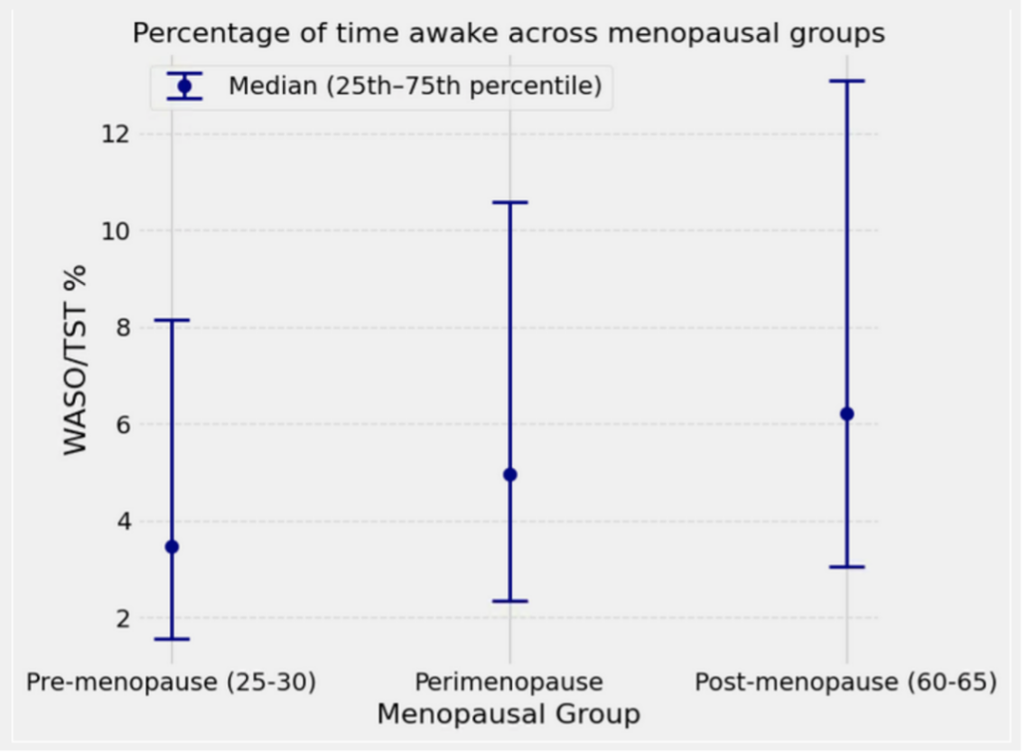
Among participants in menopause who had tracked their sleep, 84% (n=338) reported sleep changes that they attributed to their menopause transition (and a similarly high percentage, 77%, of those who did not track their sleep reported symptoms attributed to their perimenopause transition). Studying these changes helps scientists better understand sleep and perimenopause, and gives people the chance to notice when their sleep patterns are shifting in ways that could signal perimenopause even before periods stop completely.
Are menopause symptoms linked with sleep changes among AWHS participants?
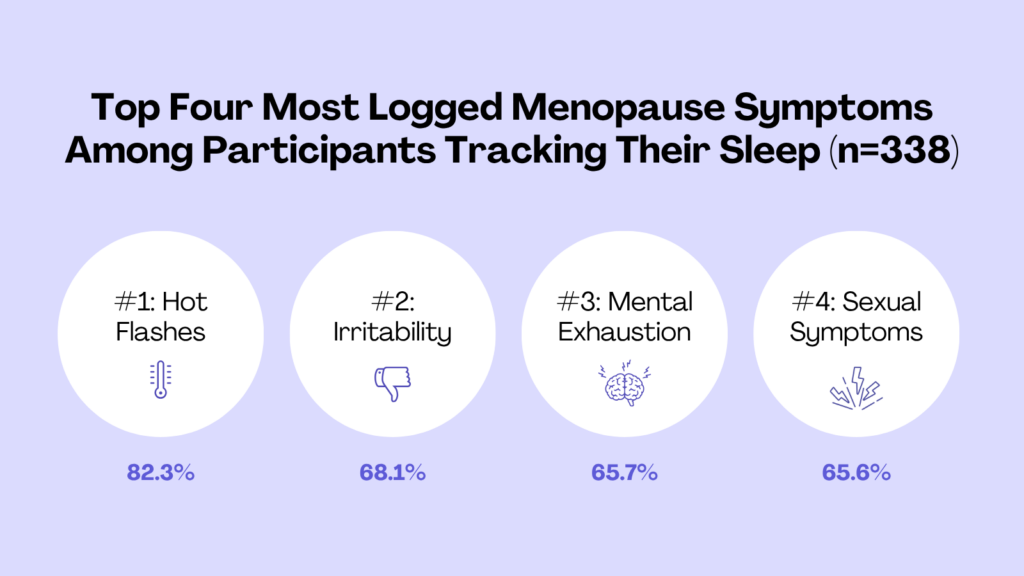
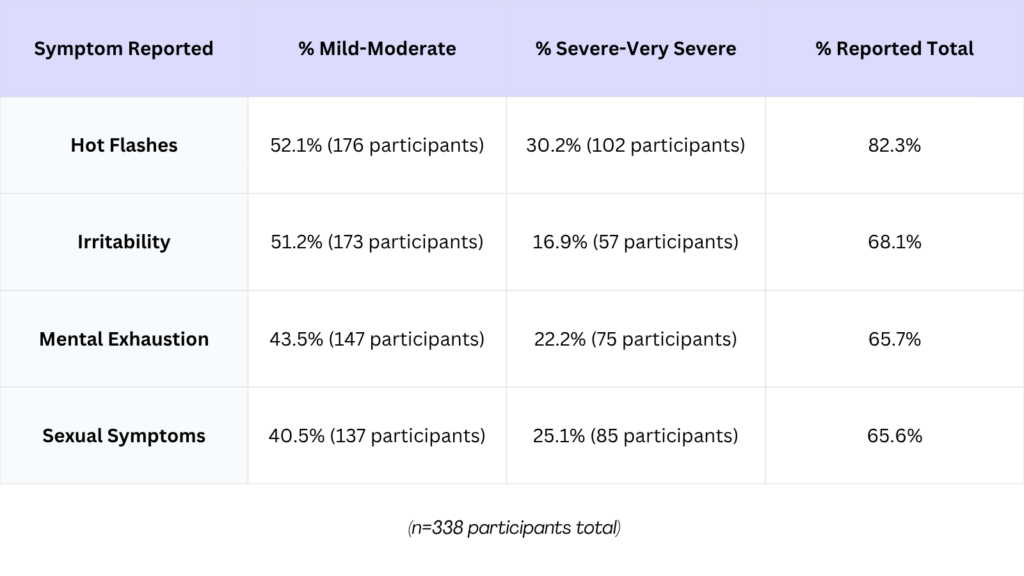
Our research team found that among those tracking their sleep during perimenopause, the symptoms they most often reported were hot flashes, irritability, mental exhaustion, and sexual symptoms.
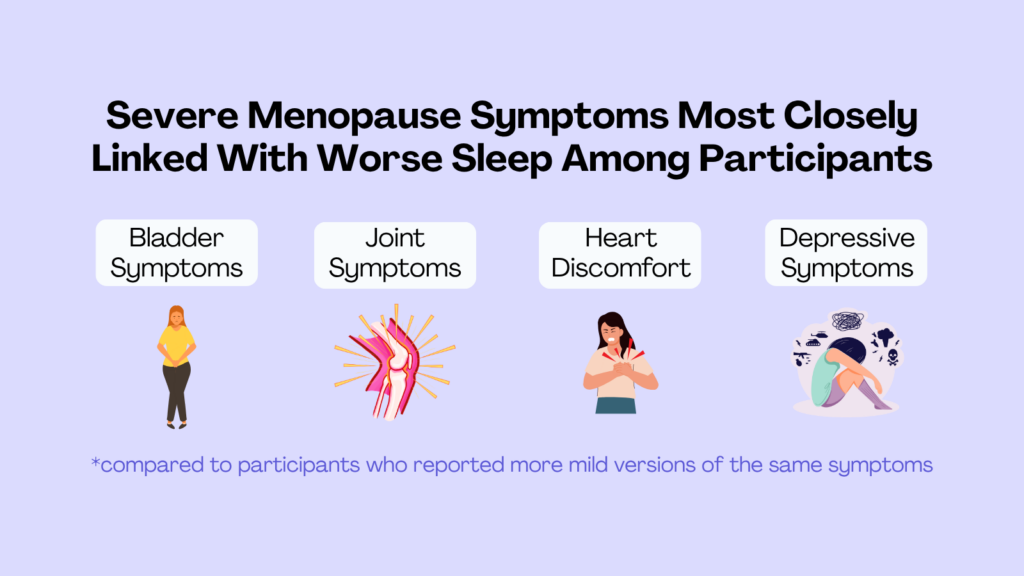
The participants that reported more severe bladder, joint, heart discomfort and/or depressive symptoms had more disruptive sleep, compared to those that reported mild symptoms. These participants were also found to have the least amount of sleep.
However, it’s important to remember that there is no one-size fits all for someone’s experience transitioning to menopause.
How can you get better sleep during perimenopause?
As with other big changes throughout your life – like puberty – hormonal fluctuations and body changes during perimenopause can impact how you feel. While not all sleep issues can be prevented, it always helps to follow best practices to increase your chances of a good night’s sleep. Read on for science-backed tips below.
- Maintain a cool temperature in your sleeping environment.
The National Sleep Foundation recommends keeping your bedroom between 60-67° Fahrenheit8. Consider sleeping with several layers of bedding, allowing you to add or remove them if you experience temperature fluctuations like hot flashes. Keeping extra blankets (or a fan) right by the bed rather than across the room can help avoid extra trips up out of bed.
- Keep a consistent sleep schedule.
Aim to go to bed and wake up around the same time every day, even on weekends9. Maintaining a consistent sleep schedule and pattern supports circadian health and better sleep quality9.
- Get regular movement in.
Weight-bearing activities and aerobic activities (as they are safe and tolerated) help promote good health, mood, and libido10,11.
- Avoid common bladder irritants and limit fluids in the hours leading up to bedtime.
Changes to urinary habits, like increased urgency, are common in perimenopause. This is due to changes in hormones that support important tissues and muscles in the urinary tract12. Avoiding excess fluids may help you wake up to pee less at night13.
- Prioritize relaxation and mindfulness techniques in your bedtime routine.
Mindfulness practices like meditation can be effective in improving sleep quality and symptoms of depression/anxiety in perimenopausal women14,15. Incorporating other calming activities like a warm bath or reading can help signal to your body over time that it’s time to prepare for sleep too.
Download a fact sheet with the tips above and the science behind them here.
Conclusion
Early identification of perimenopausal transition may lead to practicing better sleep hygiene. Monitoring your sleep, just like monitoring your menstrual cycle, helps you identify regular patterns so you can more quickly identify changes or when something may be wrong in the future. Wearable devices like the Apple Watch can help accurately measure your sleep quality (including total sleep time, time in bed, and consistency). They can also help you set a regular sleep schedule more easily. These devices can also help you identify a possible health issue or just something to pay more attention to (for example, taking more naps than usual).
By logging sleep patterns and any other new symptoms, you are helping bring attention to a time in life that’s too often left out of the conversation. Your participation in reproductive health research, even if you are no longer menstruating, helps scientists understand how perimenopause affects people in real life – not just in theory. Thank you for helping to break the silence and stigma that surrounds midlife.

The Apple Women’s Health Study team is grateful to its participants for their continued contributions to public health research.
More information on the Apple Research app & Privacy
- 1: H. M. Kravitz and H. Joffe, “Sleep During the Perimenopause: A SWAN Story,” Obstet Gynecol Clin North Am, vol. 38, no. 3, 2012.
- 2: A. K. Wegrzynowicz, A. C. Walls, M. Godfrey and A. Beckley, “Insights into Perimenopause: A Survey of Perceptions, Opinions on Treatment, and Potential Approaches,” Women (Basel, Switzerland), vol. 5, no. 1, 2025.
- 3: Office on Women’s Health, “Menopause basics,” 17 March 2025. [Online]. Available: https://womenshealth.gov/menopause/menopause-basics. [Accessed 24 September 2025].
- 4: K. Peacock, K. Carlson and K. M. Ketvertis, in Menopause, Treasure Island, StatPearls Publishing, 2023.
- 5: National Institute on Aging, “Sleep and Older Adults,” 6 February 2025. [Online]. Available: https://www.nia.nih.gov/health/sleep/sleep-and-older-adults.
- 6: F. C. Baker, “Optimizing Sleep across the Menopausal Transition,” Climacteric, vol. 26, no. 3, 2023.
- 7: National Sleep Foundation, “What Is Sleep Quality?,” 12 April 2024. [Online]. Available: https://www.thensf.org/what-is-sleep-quality/.
- 8: National Sleep Foundation, “10 Tips for a Better Night’s Sleep,” 2025. [Online]. Available: https://www.thensf.org/sleep-tips/.
- 9: “Sleep timing, sleep consistency, and health in adults: a systematic review,” Applied Physiology, Nutrition, and Metabolism, vol. 45, Jean-Philippe Chaput; Caroline Dutil; Ryan Featherstone; Robert Ross; Lora Giangregorio; Travis J. Saunders; Ian Janssen; Veronica J. Poitras; Michelle E. Kho; Amanda Ross-White; Sarah Zankar; Julie Carrier.
- 10: U. D. o. V. Affairs, “Coping with Perimenopause,” 2025. [Online]. Available: https://www.veteranshealthlibrary.va.gov/diseasesconditions/WomensHealth/142,86195_VA. [Accessed October 2025].
- 11: M. Zhao, M. Sun, R. Zhao, P. Chen and S. Li, “Effects of exercise on sleep in perimenopausal women: A meta-analysis of randomized controlled trials,” EXPLORE, vol. 19, no. 5, pp. 636-645, 2023.
- 12: L. R. D. Varella, R. B. d. Silva, M. C. E. d. Oliveira, P. H. A. Melo, T. M. d. O. Maranhão and M. T. A. B. C. Micussi, “Assessment of lower urinary tract symptoms in different stages of menopause,” Journal of Physical Therapy Science, vol. 28, no. 11, p. 3116–3121, 2016.
- 13: Brigham and Women’s Hospital Urogynecology Group, “Dietary Bladder Irritants to the Bladder,” 2015. [Online]. Available: https://www.brighamandwomens.org/assets/BWH/obgyn/pdfs/bladder-irritants.pdf.
- 14: C. F. S. Portella, I. C. E. Sorpreso, A. d. S. M. d. Assis, L. C. d. Abreu, J. M. S. Jr., E. C. Baracat, S. D. T. d. A. Moraes and A. C. D. Tanaka, “Meditation as an approach to lessen menopausal symptoms and insomnia in working women undergoing the menopausal transition period: A randomized controlled trial,” Advances in Integrative Medicine, vol. 8, no. 4, pp. 278-284, 2021.
- 15: C. Xiao, C. Mou and X. Zhou, “Effect of mindfulness meditation training on anxiety, depression and sleep quality in perimenopausal women,” Journal of Southern Medical University, vol. 20, no. 39, 2019.
- 16: Office on Women’s Health, “Sleep and your health,” 30 May 2025. [Online]. Available: https://womenshealth.gov/mental-health/good-mental-health/sleep-and-your-health. [Accessed October 2025].
- 17: E. C. Harding, N. P. Franks and W. Wisden, “The Temperature Dependence of Sleep,” Frontiers in Neuroscience, vol. 13, 2019.