Pediatric ICU nurse brings clinical insight to global health policy analysis
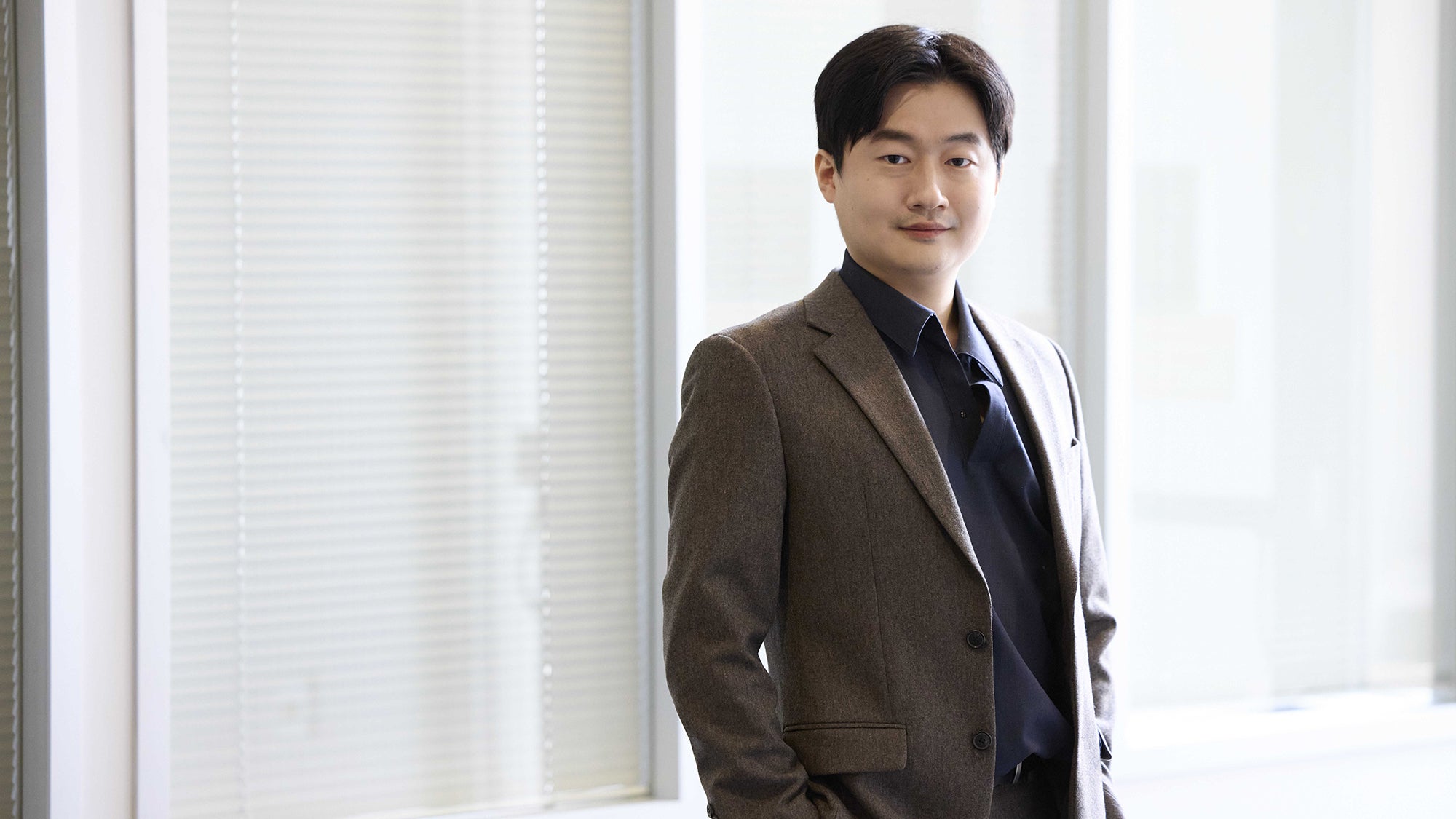
Heesu Shin, SM ’26, took care of kids while working at a hospital in South Korea. Now he’s helping them on a larger scale through his health systems research.
It’s rare for a man to become a pediatric ICU nurse in South Korea, but that didn’t deter Heesu Shin. From a young age he’d wanted a career helping people, having grown up in fishing villages where the effects of poverty and inequality were inescapable. He also had friends who’d suffered from diseases they’d had since birth, and he wanted to help kids like them. As he gained experience—through nursing and on global health fieldwork trips—he realized that he could help kids on a larger scale through research around how health systems can improve their care.
Shin came to Harvard T.H. Chan School of Public Health to build his skills in research methods and will be graduating with a master of science degree from the Department of Global Health and Population in May.
“I’ve always wanted to understand people’s lives and their health needs comprehensively,” he said, seeing his research is an extension of his clinical work. “Nurses accompany patients at the bedside. We do direct interventions to cure their illnesses. But on top of that, we work to understand them.”
From the ICU to military service
Shin’s shifts on the pediatric ICU at Samsung Medical Center in Seoul were long and demanding—and came with some extra complications, like the fact that there was no restroom for men near the nurses’ station. He said that he did encounter some puzzled looks and resistance due to his gender, but he was able to counter them with professionalism and positivity. And he loved the work.
It also got him thinking about how the hospital fit into the broader health system. He knew that policies and operations could be affected by the government and other external factors. Wanting to understand decisionmakers’ perspectives, he enrolled in evening classes for a master of public policy program at Seoul National University.
To get a perspective on health needs in other countries, he spent his vacations traveling to Ethiopia, Nepal, and Uzbekistan on fieldwork trips. He conducted research, consulted with local teams, and provided training to help hospitals strengthen their ability to deliver specialized care, including pediatric and cardiac surgery programs.
Shin stepped away from his work at Samsung Medical Center in 2020 for mandatory military service and experienced the start of the COVID-19 pandemic while he was in bootcamp. He was eventually deployed as an Air Force nursing officer to cities around the country to assist with testing and acute care, and later led the emergency response at his hospital following a military aircraft crash.
Pursuing global health impact
These experiences further broadened Shin’s perspective on public health and prompted him to want to go back to school. He was attracted to Harvard Chan School’s master of science program for its research-centered, methodology-oriented focus. His cohort has been a bonus.
“The small community of the global health SM degree cohort is really amazing. We all meet periodically to share information and chat about how things are going. It really helps,” he said.
Shin received a partial scholarship and chose concentrations in maternal and child health and humanitarian studies. He trained his research lens on equity-focused policy evaluation using decision-analytic modeling (a method for predicting the likely results of different decisions) and other approaches. For example, for his thesis, he analyzed the cost-effectiveness of adolescent health interventions in Ethiopia, the location of one of his previous fieldwork trips. During Marcia Castro’s Geospatial Methods in Public Health class, he explored associations between health care coverage and birth rates in South Korea, and whether pediatric care facilities are available in the parts of the country where they are most needed.
“Heesu is committed, sharp, and possessed of a deep curiosity,” said his adviser Stéphane Verguet, associate professor of global health. “He is, in essence, a top-notch student on the path to make a superb impact in global health.”
After graduation, Shin will be heading to the UK for a PhD in global health systems at Oxford University. He’ll be focusing on continuity of care pathways for children around the globe with complex diseases, exploring obstacles and inequalities they face and what health systems can do to address them.
Looking farther ahead, he hopes to continue conducting this type of research, likely in academia. “I want to be a policy analyst who can bring real-world insight from clinical and development experience to decision making,” he said.
Quick hits
One of my favorite ways to unwind is through community volunteering. Before coming to the U.S., I was actively involved in a volunteer club in Korea. We organized activities such as running telemedicine clinics in rural areas and helping local farmers during harvest seasons.
Something people might not know about me is thatI’m quite good at fixing and assembling small items. I enjoy building LEGO or plastic models, and I often end up helping friends assemble or repair items like jewelry. It’s a skill that requires patience and attention to detail, similar to my pediatric ICU care experience.
A movie I like to recommend is Good Will Hunting. It’s about great mentorship. There are many people with talent, and it’s the role of the educator or leader to identify and nurture that talent.