Student’s health equity nonprofit makes Harvard President’s Innovation Challenge finals
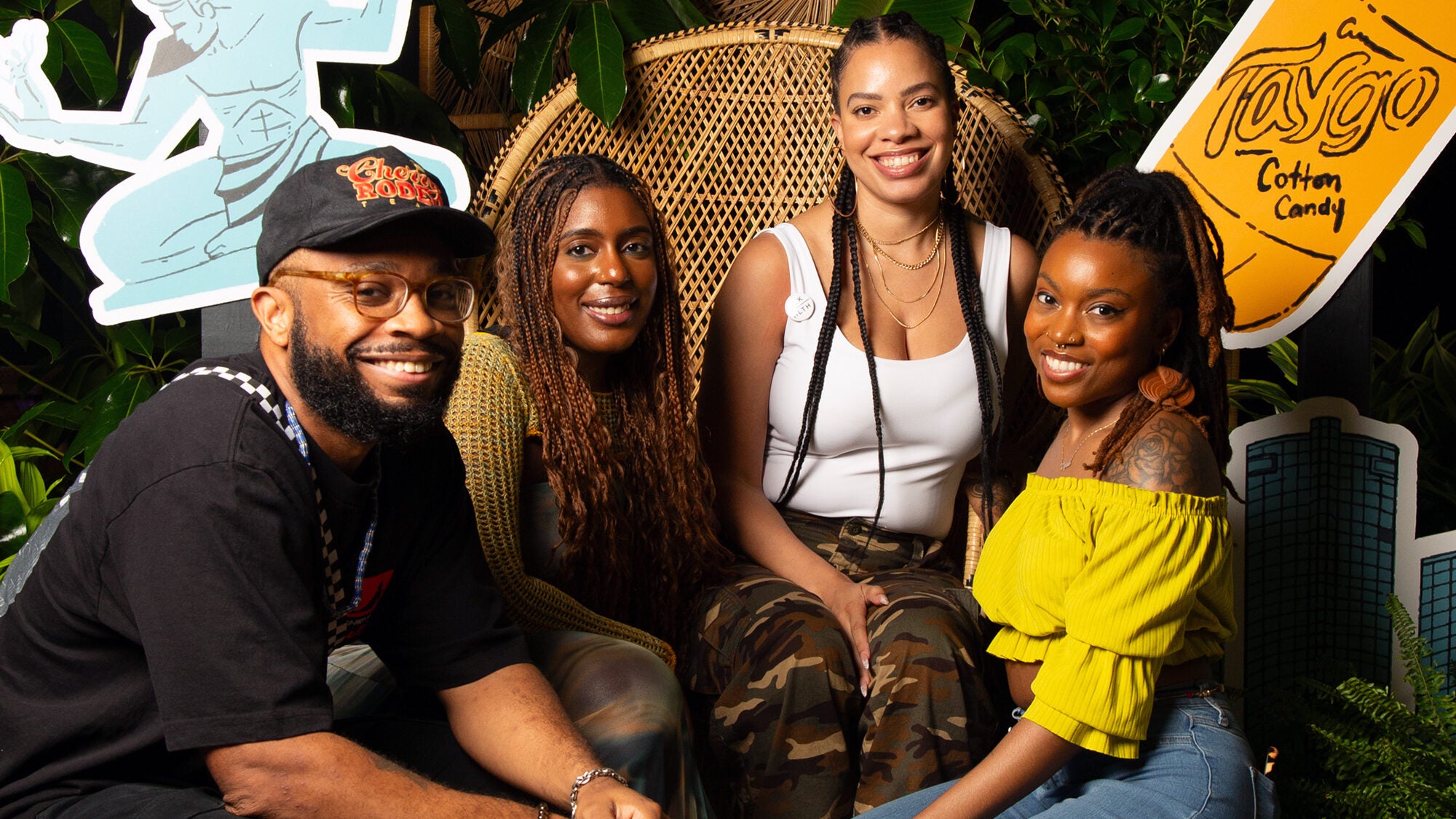
BLKHLTH, a nonprofit founded by Matthew McCurdy, DrPH ’28, was selected as one of 25 finalists in the 2026 Harvard President’s Innovation Challenge. Finalist teams were announced by Harvard Innovation Labs on March 27. BLKHLTH—which aims to advance health equity in Black communities through education, advocacy, research, and programs—will compete for up to $75,000 in prize money at the May 6 awards ceremony. McCurdy recently spoke about his organization and how the Innovation Challenge is helping him refine his vision.
Q: How did BLKHLTH get started?
A: I met my co-founders [Khadijah Ameen, Mercilla Ryan-Harris, and Paulah Wheeler] at Emory University’s Rollins School of Public Health during our MPH program. This was in 2014, and we were noticing the discourse around police brutality in Black communities. At the same time, our courses were talking about racial health disparities but not really getting at the root causes— systemic and institutional racism. And we didn’t hear a ton of solutions, which really frustrated us. So, we started organizing on campus and shortly after graduation in 2016 started BLKHLTH. I became the full-time executive director in 2021.
At that time, there was a lot more attention on racial health equity work because of the disparities that folks saw during the COVID-19 pandemic. That was also around the time of the murder of George Floyd and other instances of state-involved violence. This renewed attention to our cause, and with it came funding. Our first big opportunity came that year to do work around colorectal cancer screening in Black communities. We partnered with Cottonelle to distribute around 20,000 screening kits across 49 states and pay for 300 colonoscopies for uninsured and underinsured patients.
Q: What are some of the challenges that you faced in growing the organization?
A: I thinkit’s tough for any nonprofit organization to figure out where funding is going to come from. When you are constantly chasing dollars, it’s really hard to stay attuned to mission. And it’s been a blessing but also a challenge to build an organization with friends. Life happens. People go back to school or have kids, and those relationships are tested. But I think we’re fortunate that we have a strong team built on a foundation of trust and mutual accountability.
Our current political moment is a real challenge, as well, as we see the rollback of equity efforts and the destruction of public health infrastructure. This means that our organization is needed even more, but there are fewer resources to do the work.
Q: What makes you proud about BLKHLTH and what you’ve accomplished so far?
A: Every time that we host an event or I’m out in community, it’s reflected back how much we’re needed—whether it’s delivering resources, culturally tailored education, or health experiences that exist outside of health care facilities. We’ve been particularly successful in places like Atlanta, where the organization was founded, and are also now working in Johannesburg, South Africa. We know that many people feel hesitant to engage with the health care system because of both personal experiences of racism and the historical legacy of racism in health care. That is why we create culturally affirming, community-based ways for people to engage with health, while also working with legacy institutions toward greater accountability.
We recently partnered with Amgen to host cholesterol screening at the Congressional Black Caucus Annual Legislative Conference, where we reimagined the bodega as a space for health and well-being. Our broader vision is to build permanent health opportunities in communities that make care and health resources more accessible in non-traditional settings.
This culturally affirming model has an impact. In partnership with the CDC Foundation to distribute a series of materials around maternal morbidity—early warning signs that something may be wrong for the mother. The materials they had didn’t have culturally responsive images, so, we worked with an artist to redesign them, and have distributed them at events across the country.
We had a staff member at the time who was pregnant and realized she was experiencing symptoms mentioned in the materials. She immediately called her physician and got care. That’s just one small example, but we’ve heard numerous other stories like it. We’ve seen that when we create things with our intended audience in mind, it can help them start to reflect on their own health behaviors and symptoms and maybe make some changes.
BLKHLTH has also been doing quite a bit of advocacy capacity building through the BLKHLTH Community Advocacy for Racial Equity School (CARES), our advocacy fellowship program for the next generation of health professionals. Over the past three years, more than 100 fellows have learned how to translate their lived experiences and stories into policy recommendations.
Recently, CARES fellows joined us at our inaugural BLKHLTH workforce day at the Georgia Capitol to advocate for protecting current and future Black health workers. Throughout the day, fellows learned about the Georgia legislative process and educated their state legislators about key issues impacting them, including workforce pipeline development, health sciences infrastructure, licensure and reimbursement reform, workforce benefits and protections, and workforce basic needs. Fellows also participated in a press conference with Health Students Taking Action Together to announce the introduction of legislation to establish single-payer health care in Georgia.
Q: What brought you to Harvard Chan School for your DrPH?
A: I came here looking for ways to scale my impact and learn the avenues through which we can actually implement and effect change. The combination of the rigorous public health and leadership training in the DrPH program, and the network and resources of the broader Harvard ecosystem really attracted me. I think the program has helped me re-examine the path forward and the role that I can play.
Q: What has participating in the President’s Innovation Challenge done for BLKHLTH?
A: Our organization was already undergoing change, and the Challenge has really supported me in articulating the new vision. We started off delivering services and programs to people. We’re moving towards more of a capacity-building, systems-change organization. I think the process of refining our pitch for the judging portion of the competition has certainly helped and I’ll do quite a bit more of that over the next few weeks.
Q: What are your goals for the organization moving forward?
Q: In the short term, we’re looking to really narrow in on a strategy and identify partners, opportunities, and resources aligned with that strategy. The long-term goal is continued impact. We want to see improved health outcomes for Black communities. We want to see empowered communities who are affecting policy and program change. And we want to enable a movement toward health equity for Black people.