Remembering Barry Bloom
To the Harvard Chan community:
It is with profound sadness that I write to inform you that former dean Barry R. Bloom passed away Wednesday evening following a long battle with cancer. Barry, the Joan L. and Julius H. Jacobson Professor of Public Health, Emeritus, in the Department of Immunology and Infectious Diseases, was 88.
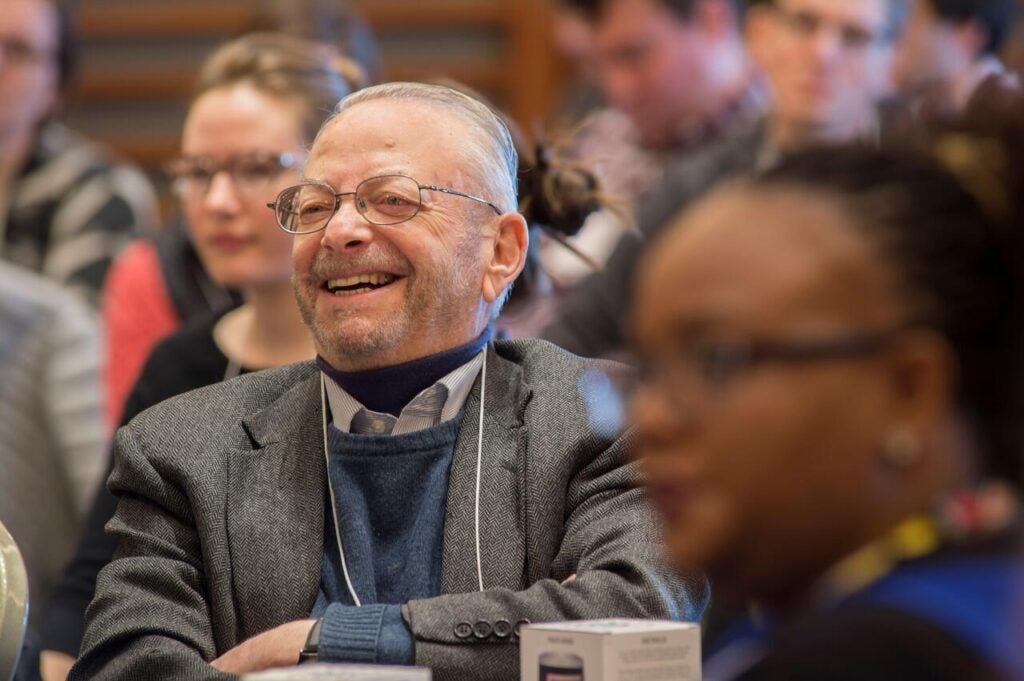
Barry was a global health pioneer, committed to bringing knowledge and cutting-edge basic science methods to alleviating the burden of disease in developing countries. He was a renowned immunologist known for his research on immune responses to infectious diseases, including tuberculosis, leprosy, malaria, and COVID-19.
Barry served as dean of Harvard T.H. Chan School of Public Health from 1999-2010, during which he had a deep commitment to scientific discovery and discourse and to developing the next generation of global health leaders. One highlight from his tenure was helping the School establish the Public Health Foundation of India in 2006 in collaboration with the Indian government, the Gates Foundation, and other public and private partners, which to date has set up a network of six public health institutions.
His lab first established that lymphocytes, not macrophages, had specificity for antigens and that activated T cells released a new category of non-antibody proteins, now known as cytokines. Barry’s laboratory defined immune responses for protection against tuberculosis in animal models and established the molecular mechanisms by which mouse, and in later collaborations, human macrophages carry out antimicrobial activity against M. tuberculosis and other intracellular pathogens. His collaborations also led to the development of new vaccine candidates against tuberculosis and he was a strong advocate for the cost-effectiveness of vaccines to prevent death and disease in developing countries.
Barry shared his experience and expertise as a valued advisor to multiple organizations. He served as an advisor to the Carter White House on international health policy. He served on scientific committees at the National Institutes of Health and the Centers for Disease Control and Prevention. For more than 40 years, he was an advisor to the World Health Organization and chaired the research advisory committees on leprosy, tuberculosis, malaria, and tropical diseases. Barry chaired the Vaccine Advisory Committee of UNAIDS and served on many scientific advisory boards, including the Rockefeller Foundation, the Wellcome Trust, and the Howard Hughes Medical Institute, where he also served as an investigator. He was elected to membership in the National Academy of Sciences, National Academy of Medicine, American Academy of Arts and Sciences, and American Philosophical Society. He received the first Bristol-Myers Squibb Award for Distinguished Research in Infectious Diseases, the Robert Koch Gold Medal for lifetime research in infectious diseases, and shared the Novartis Award in Immunology.
He received an AB in biology from Amherst College and a PhD from The Rockefeller University. From 1978 to 1990, he served as chair of the Department of Microbiology and Immunology at the Albert Einstein College of Medicine.
I would like to share the following quotes from some of Barry’s colleagues:
Sarah Fortune, chair of the Department of Immunology and Infectious Diseases: “Barry was a great inspiration, colleague, and friend. He was a fierce advocate for science in the service of the most vulnerable people in the world. He also trained generations of researchers. As a mentor, he was exceptionally generous with his time and wisdom and a role model for the importance of teaching, a legacy that we will seek to carry on.”
Marc Lipsitch, adjunct professor of epidemiology: “Better than perhaps anyone else I know, Barry integrated scientific curiosity and rigor with a deep engagement in making the world better and the public healthier. He changed my life by making it possible for me to come to Harvard, generously offering me part of his laboratory space for my own small lab, solving the one blocker that was keeping me from coming to the School. I have treasured his friendship and his blunt critiques offered with warmth and kindness, and I will miss him very much.”
Eric Rubin, adjunct professor of immunology and infectious diseases: “Barry was an incredibly charming companion and friend and the go-to guy for advice, which he offered frequently and genuinely. He was a raconteur, telling stories ranging from his many travels around the world (which had a profound influence on his research), his involvement with the Radiation Effects Research Foundation to learn from the survivors of the atomic bombings in Japan, and his musings on the state of immunology and his life with his beloved wife Irene.”
Jorge Chavarro, dean for academic affairs: “When I arrived at the School in 2002 as an SM student, Barry, in his welcome remarks, said that we had just joined the only School at Harvard where we were all but guaranteed to make less money than whatever other career path we may have chosen. But that personal gain was not the reason any of us were in Snyder auditorium. It was because we were willing to put our talents in the service of improving health around the world.”
Barry had recently finished writing his memoir, “A Global Health Odyssey: Adventures in Science and Policy,” and I’m happy to share that it will be available soon (ebook and print) for free at Countway Library for Harvard ID holders.
Barry was predeceased by his wife Irene, a distinguished scholar of Chinese philosophy and chair of Asia and Middle Eastern Studies at Barnard College. He is survived by his daughter, Inae Bloom, and grandson, Mars Bloom.
Barry’s life will be celebrated at a memorial service, details below, an RSVP is encouraged:
Date: May 22, 2026
Time: 10 a.m. – 1 p.m.
Location: AAAS, 136 Irving Street, Cambridge, MA 02138
RSVP Link: Barry Bloom Memorial-RSVP
Sincerely,
Andrea
Andrea Baccarelli, MD, PhD
Dean of the Faculty