Community Engagement in Public Health Research and Practice Concentration
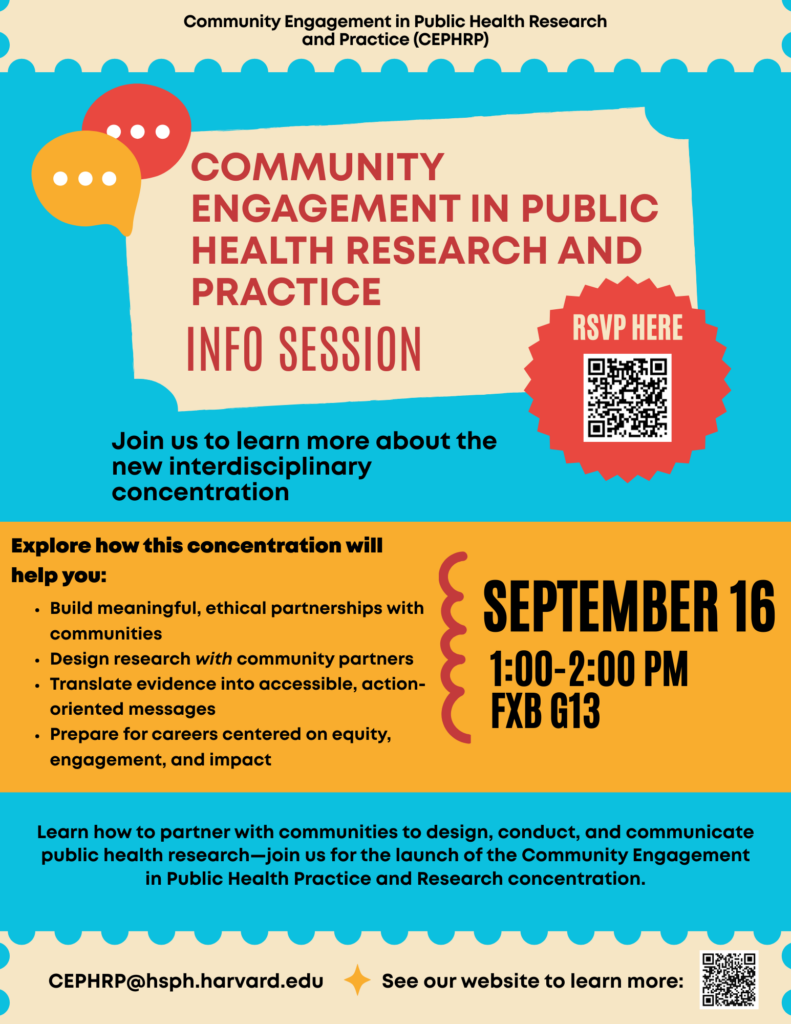
Join us to learn more about the new concentration in Community Engagement in Public Health Research and Practice.
Wednesday, September 16, 2026
1:00-2:00pm in FXB G13
Introduction
Community engagement has emerged as a critical paradigm within public health. Engaging communities as genuine partners in research and interventions ensures that public health programs are culturally grounded, ethically sound, and responsive to health inequities and the social determinants of health.
To be launched in fall 2026, the interdisciplinary concentration in Community Engagement in Public Health Research and Practice at Harvard T.H. Chan School of Public Health prepares students to build the knowledge, skills, and experience needed to work in partnership with communities – locally and globally – and to advance more equitable public health research and practice.
Goals
The concentration is designed to enable students to:
- Build foundational knowledge in the principles, theories, and methods of community engagement, grounded in historical context, best practices, and ethical considerations.
- Develop practical skills for designing, implementing, and evaluating public health research and interventions in partnership with communities, with emphasis on communication, cultural humility, facilitation, and shared decision-making.
- Foster reflective practice and professional identity, helping students cultivate an ethic of reciprocity, equity, and advocacy in their approach to public health.
- Gain mentorship, hands-on project experience, and access to networks that connect students with community partners, faculty, and practitioners committed to engaged public health.
- Contribute to the growth of a vibrant, interdisciplinary community dedicated to advancing health equity and the sustainability of public health initiatives through genuine community partnership.
Curriculum
The Community Engagement in Public Health Research and Practice concentration requires 7.5 credits for successful completion. All courses must be taken for a letter grade to be counted towards this concentration. Students will work with concentration leadership to design a curricular pathway aligned with their interests and career goals. To complete the concentration, students will complete 7.5 credits total:
- 2.5 credits from an approved list of core courses, and
- 5.0 credits from approved electives
Core courses span multiple departments and focus on community-based participatory research, implementation and evaluation, health and foundational theoretical frameworks. Elective options allow students to deepen skills in areas such as communication, implementation and evaluation and practice and research. Students may also petition the concentration committee to include alternative courses that align with the concentration.
Students will complete at least 2.5 credits from these courses:
- SBS 501 (2.5 credits): Community-based Participatory Research: Principles, Process, and Practices
- GHP 551 (2.5 credits): Community Health Promotion: An International Perspective
- SBS 204 (2.5 credits): Program Implementation and Evaluation
- SBS 210 (2.5 credits): Introduction to Dissemination and Implementation Science
- EH 291 (5 credits): Community Practice in Environmental Health
Students will complete any additional courses from the list below to complete 7.5 credits total. Students may petition the concentration committee to include alternative courses.
| COMMUNICATION | IMPLEMENTATION & EVALUATION | PRACTICE & RESEARCH |
|---|---|---|
| SBS 225 (2.5 credits): Engaging with the US Press: A Practical Look at Effective Public Health Communication | NUT 232 (5 credits): Designing and Evaluating Behavioral Interventions Targeting Diet | SBS 551 (1.25 credits): Community Based Participatory Research: Field Engagement and Practice |
| SBS 515 (2.5 credits): Health Literacy – Practical Tools to Make Information More Equitable | NUT 213 (2.5 credits): Nutrition Science Translation and Applications | Practicum course (2.5 credits): for a practicum that addresses a community engaged topic (approved by concentration committee) |
| HPM 562 (2.5 credits): Narrative Leadership – Using Storytelling to Mobilize Collective Action in Public Health | SBS 203 (2.5 credits): Program Planning: Community Health Assessment and Prioritization | GHP 542 (2.5 credits): Field Trip to Brazil Other travel courses to be approved by concentration committee. |
| EH 286 (2.5 credits): Environmental Health Literacy and Science Communication | GHP 504 (2.5 credits): Introduction to Qualitative Research for Global Health | DrPH 200 (2.5 credits): Qualitative Methods in Health Research: Practice, Principles, and Critical Considerations |
Beyond coursework, students will participate in a set of co-curricular activities that reinforce learning and community-building:
- Monthly “lunch and learns” featuring community partners, practitioners, and faculty engaged in community-based work.
- Opportunities to learn from and collaborate with centers and initiatives across Harvard Chan (e.g., environmental health, cancer equity, health and happiness, nutrition and physical activity, health and homelessness, racial justice, immigrant health, and campus-wide community engagement efforts).
- A growing network of peers, faculty, and staff committed to community-engaged public health.
Students in the concentration are expected to attend at least two lunch and learns or equivalent events per semester and are encouraged to actively engage in networking, mentorship, and collaborative projects.
Enrollment
The concentration is sponsored by the Departments of Social and Behavioral Sciences, Environmental Health, Health Policy and Management, and Global Health and Population, with strong collaboration with the Office of Community and Belonging and the Office of Educational Programs, and centers and initiatives across the school.
All MPH, SM, DrPH, PhD students at the Harvard Chan School are eligible to participate in the concentration. Students must be enrolled in a residential degree program. Students complete the concentration alongside their primary degree. Those who meet the requirements will receive a certificate of completion in Community Engaged Public Health.
- Community engagement seminars: students will join the broader community engagement concentration for at least 75% of monthly lunchtime seminars over one academic year.
- Core courses: students will complete at least 2.5 credits from the listed foundation courses for the concentration. See Curriculum for course listing.
- Elective courses: students will complete additional courses under Communication, Implementation and Evaluation, or Practice and Research. See Curriculum for course listing.
- Students may petition the concentration committee to include alternative courses.
Please complete this form to express interest in this concentration. Our staff will be in touch with you soon.
People



Upcoming Events
-
Community Engagement Concentration Information Session
Join us to learn more about the new interdisciplinary concentration. Explore how this concentration will help you: Speaker Information Organizers
-
Community-Engaged Research Working Group in Environmental Health
Join the Harvard Chan NIEHS Center’s working group on community-engaged research in environmental health! This working group brings together faculty, trainees, students, and staff to discuss the methods and practice…