2025 Message from the Chairs
While this year has brought more than its share of challenges for our field, our school, and our department, it has also underscored the resilience, creativity, and dedication of our community. Even in the face of substantial change and uncertainty, our faculty, students, researchers, and staff continued to conduct high-impact work in both research and education and support one another. As we reflect on 2025, there is much to appreciate, and much to build on, as we step into the year ahead. We would like to highlight a few especially notable accomplishments. Elaboration on many of these exciting milestones can be found elsewhere in this holiday newsletter.
Junwei Lu was promoted to Associate Professor of Biostatistics. His research spans statistics, machine learning, and artificial intelligence, with recent work extending into natural language processing. He has translated these advances into tools supporting research on neurodegenerative diseases, treatment policy, and electronic health records. Rachel Nethery was promoted to Associate Professor of Biostatistics. Her research in environmental biostatistics integrates statistical and machine learning methods, high‑resolution exposure assessment, and causal inference, with recent work advancing the understanding of the health impacts of extreme climate events. She has engaged actively in policy translation. Rui Duan was promoted to Associate Professor of Biostatistics. Her research in statistical and machine learning methods for large‑scale biomedical data has had a significant impact across many methodological areas, including federated learning, causal inference, and statistical genetics. She has applied her methods to problems in areas such as precision psychiatry and children’s mental health to global health and cancer. All three of these exceptional faculty members are leaders in the educational mission of the department, teaching classes in both our PhD and masters programs, as well as each serving as research mentors for multiple students and postdoctoral fellows.
Erin Lake, Lecturer on Biostatistics and Co-Director of the Master of Science in Biostatistics Program and Director of Student Development, was selected as this year’s Nichols Award winner, one of the school’s highest teaching honors. The Roger L. Nichols Excellence in Teaching Award honors outstanding achievement in teaching, in particular for classroom instruction, dedication, and the capacity to inspire students. Erin is one of our many outstanding instructors, and we are grateful for the dedicated work of all of our instructors and their commitment to our mission of educating and mentoring our students.
Jelena Follweiler was selected as the deserving recipient of the 2026 Sarah K. Wood Award for Outstanding Staff Performance. This award recognizes staff across the school who demonstrate exceptional dedication, professionalism, and impact. It is a meaningful honor, and we are delighted that her outstanding contributions have been recognized at this level. As a department, we rely on the hard work, expertise, and commitment of our staff. They are essential to our teaching, our research, and the day‑to‑day operations that allow our academic mission to thrive. Jelena exemplifies this spirit through her care for our community and her unwavering support of our programs.
Members of our department have been heavily involved in Harvard Chan’s efforts to develop new online degree programs for learners around the world. Admissions for a new 60-credit online Master of Science program in which students take courses in a variety of public health areas, with required courses in foundational topics in epidemiology and biostatistics, health data science and artificial intelligence, launched this fall with the first cohort to be welcomed in the coming academic year. The program can be completed over four semesters, with full-time study in the first year and part-time study in the second year, or students can opt to complete the program fully part-time over the course of three years. Jeff Miller serves as faculty director of the program, with department members Heather Mattie, Jeff Miller, Junwei Lu, Rebecca Danning, and Brent Coull developing courses that will be offered asynchronously to allow students from around the world to learn on their own schedules, as well as offer optional in-person learning opportunities. More generally, our faculty, postdocs, and students continue to play a central role in the school’s educational mission, collectively delivering approximately 9,000 student credit hours of instruction.
Despite the financial challenges faced by our school, our department continued to host a vibrant colloquium series led by Nima Hejazi and Rong Ma, bringing faculty, students, and other researchers together to meet and learn from leaders in the field, many from right here in the Boston area. Of note, the department was fortunate to host three phenomenal award lectures this year. Dr. Peter Gilbert from the University of Washington delivered the Marvin Zelen Award Lecture titled “Statistical Science for the First Efficacy Trials of HIV-1 Monoclonal Antibody Prevention“ in May. Dr. Marco Carone from the University of Washington delivered the Myrto Lefkopoulou Award Lecture “Debiased Machine Learning Meets Shape Constraints: Modern Inference on Monotone Functions” in September, and Dr. Bethany Hedt-Gauthier delivered the Stephen Lagakos Alumni Award Lecture “When Ikigai Meets AI: Data-driven Solutions for Global Health Equity” in October. We highly valued the visits of the awardees as well as the opportunity to remember the individuals these awards are established to honor.
This year, our school has continued to deepen its commitment to fostering a community where everyone feels a sense of belonging and is encouraged to engage openly across differences. We are fortunate to work within a diverse community of people who bring a wide range of perspectives to our shared mission. Across the school, new efforts are underway to strengthen open inquiry, build skills for constructive dialogue, and ensure fair and respectful treatment for all. These initiatives reflect a broader commitment to creating an environment where every member of our community can thrive and contribute fully.
As we wrap up 2025, we want to express our gratitude for the dedication, generosity, and goodwill that carried us through this year. Our community’s commitment to excellence in research, teaching, and service continues to inspire confidence in the path ahead.
Thank you for being part of our community. Wishing you a joyful holiday season and a healthy, happy, and successful New Year.
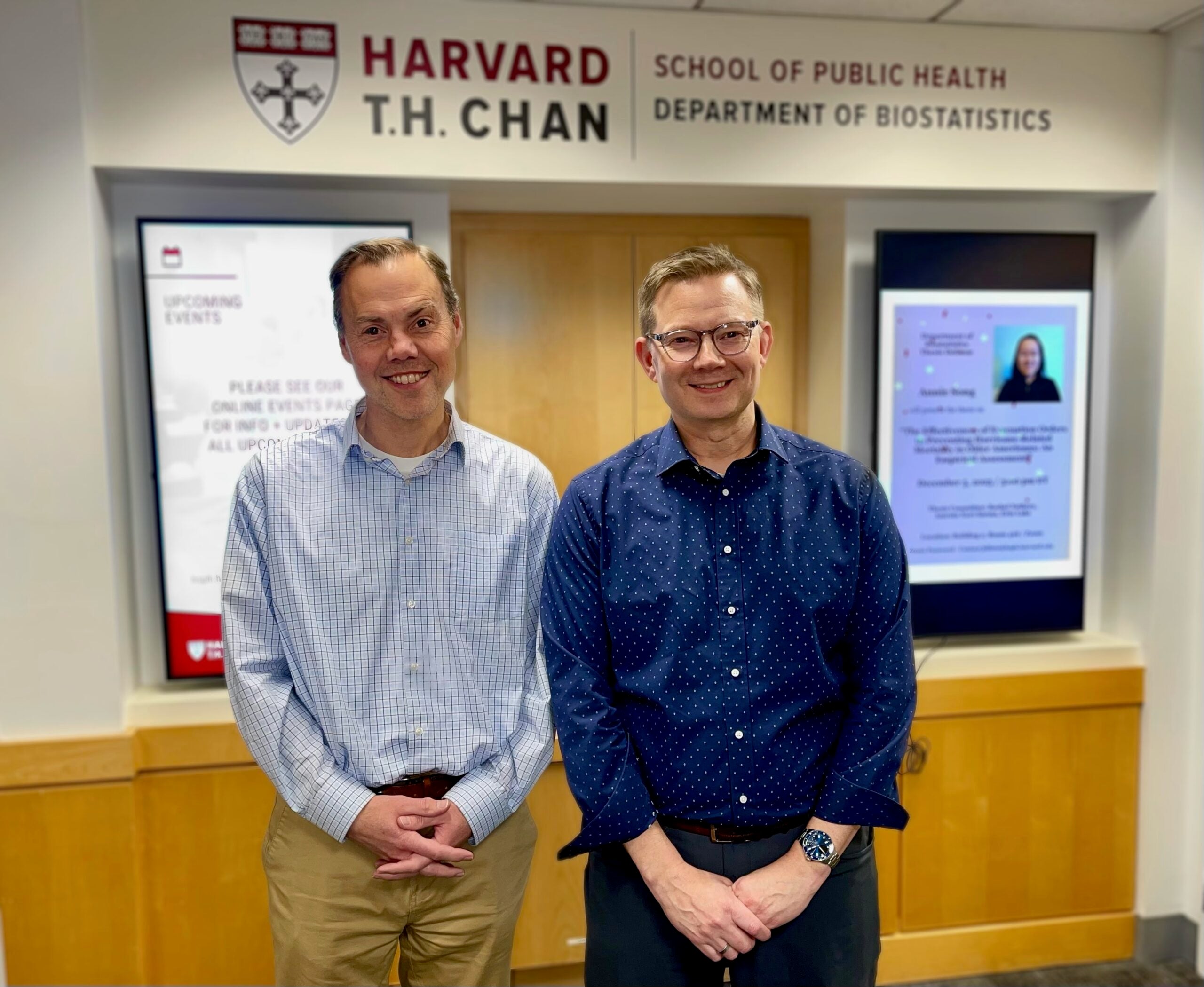
JP and Brent