Prenatal and Early Postnatal Lead Exposure, Sensitive Periods, and Later Adult Mental Health
Article link: https://jamanetwork.com/journals/jamapsychiatry/article-abstract/2840553
Reference: Lin JJY, Hickman R, Farmer J, et al. Prenatal and Early Postnatal Lead Exposure, Sensitive Periods, and Later Adult Mental Health. JAMA Psychiatry. Published online October 22, 2025. doi:10.1001/jamapsychiatry.2025.3012doi:10.1017/S0033291723002702
Study question: Are prenatal and early postnatal lead exposures associated with the risk of mental health disorders in later life?
Our study shows that people who were exposed to higher levels of lead before birth had higher risk of major depressive disorder and greater anxiety symptoms in later adulthood.
Using baby teeth from participants of the St. Louis Baby Tooth—Later Life Health Study (SLBT), we measured early life lead exposures from roughly the second trimester of gestation through about 6 months after birth. Adult depression and anxiety symptoms over the past 2 weeks were assessed using the Patient Health Questionnaire-9 (PHQ-9) and the Generalized Anxiety Disorder Screener-7 (GAD-7), respectively. In this subsample of 718 SLBT participants with tooth lead data (mean age, 62 years; 53% female), we found:
- Compared to those who were less lead exposed (25th percentile), participants who had higher (75th percentile) early life lead exposure had nearly 2 times the odds of major depressive disorder in later adulthood
- Higher lead exposure was also linked to greater anxiety symptoms in later adulthood
- The third trimester was a particularly sensitive window of lead exposure for later life mental health
- The odds of depression were higher among women than among men
Figure: The results for lead exposure across different exposure periods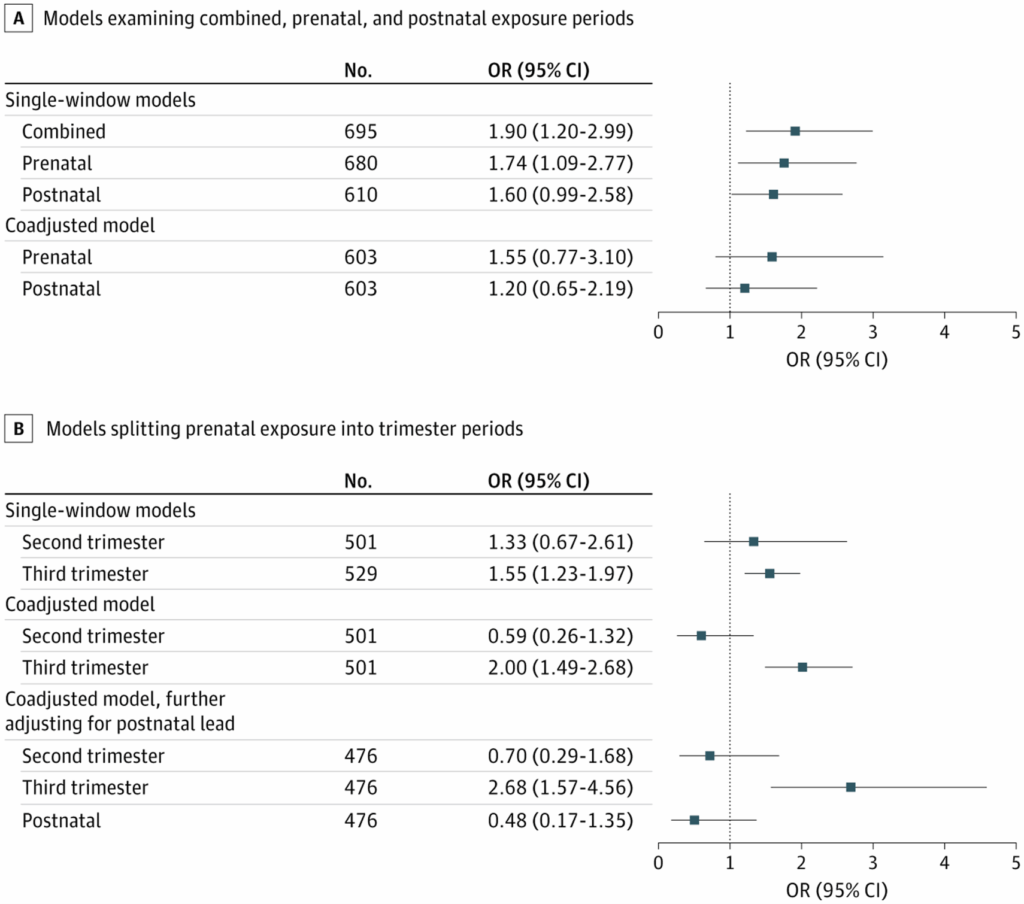 * An odds ratio (OR) is a measure of association between an exposure and an outcome. It represents the odds that an outcome will occur given a particular exposure, compared to the odds of the outcome occurring in the reference group. In this case, we compared people with higher lead exposure (75th percentile) to those with lower exposure (25th percentile). An odds ratio of 1 means there’s no difference between the groups. Values above 1 mean the outcome is more likely in the higher exposure group. This figure shows that people with higher lead exposure were more likely to have major depressive disorder than those with lower exposure. The strongest link was seen for lead exposure during the third trimester, even after considering exposure during other time periods. |
Exposure to lead persists: In the US, an estimated 9 million lead service lines may contaminate household drinking water. Globally, lead is still found in some commercial products and used in industrial processes.
Related media: