Early-life Cognitively Stimulating Activities and Late-Life Cognitive Function in the St. Louis Baby Tooth Later Life Health Study
Article link: https://www.nature.com/articles/s41598-024-79083-x
Reference: Roberts, A.L., Qiu, X., McAlaine, K.A. et al. Early-life cognitively stimulating activities and late-life cognitive function in the St. Louis Baby Tooth Later Life Health Study. Sci Rep 15, 2105 (2025). https://doi.org/10.1038/s41598-024-79083-x
Study question: Can early childhood activities that engage the brain impact cognitive abilities as people age?
Our study explored how activities that engaged the brain during childhood, like playing board games, reading, writing, and doing homework, might impact cognitive abilities later in life. We also wanted to find out if activities in early childhood (age 6), middle childhood (age 12), or teen years (age 18) had a stronger relationship with cognitive abilities as people age. We used responses from more than 4,000 members of the St. Louis Baby Tooth – Later Life Health Study, ages 55 to 77, about their childhood activities and then looked at their cognitive function, which included skills like memory, attention, and reasoning. We carefully accounted for participant’s childhood economic situation.
The results showed that study members who engaged more in cognitively stimulating activities as children tended to have better overall cognitive performance in later life. Interestingly, when we looked more closely at the age that seemed to matter most for these benefits, only activities at age 18 had a significant link to better cognitive health in older age. Moreover, the benefits were most noticeable for those who had fewer of these activities during their late teens – the difference between doing no activities and doing a few activities was associated with much better cognitive outcomes, whereas there was a smaller difference between doing a high versus moderate amount of activities.
Different cognitive skills were linked to childhood activities to varying degrees. Verbal reasoning, or the ability to use language and logic, had the strongest connection, while other skills like processing speed and attention were less associated.
Our study suggests that encouraging mentally engaging activities, especially during the late teen years, could be beneficial for long-term cognitive health, particularly for individuals who may have limited access to such activities.
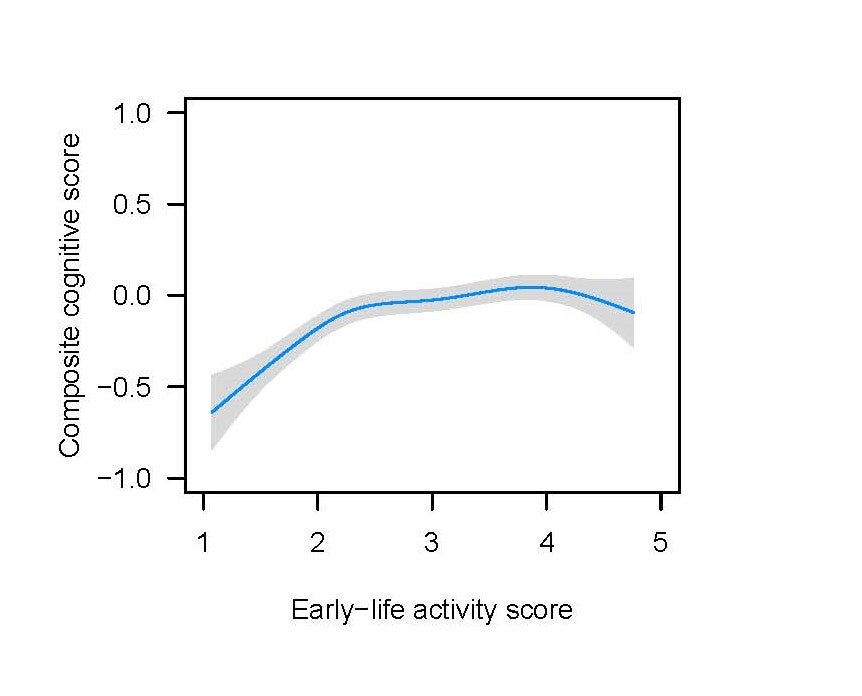 Figure. This figure shows the relationship between cognitively stimulating activities at age 18 and cognitive scores in later life. The blue line represents the estimated relationship with cognitive scores, and the grey band around it shows the uncertainty in that estimate— a wider band means less certainty. Generally, people with fewer activities at age 18 had worse cognitive functioning in later life, although these differences were mostly evident at the lower levels of activity (a score of 1 or 2). We saw little difference between people with a medium level of activity (score 3) and those with a high level of activity (scores of 4 or 5). Figure. This figure shows the relationship between cognitively stimulating activities at age 18 and cognitive scores in later life. The blue line represents the estimated relationship with cognitive scores, and the grey band around it shows the uncertainty in that estimate— a wider band means less certainty. Generally, people with fewer activities at age 18 had worse cognitive functioning in later life, although these differences were mostly evident at the lower levels of activity (a score of 1 or 2). We saw little difference between people with a medium level of activity (score 3) and those with a high level of activity (scores of 4 or 5). |